Cul-de-Sac Circuits: The Festive Lights Walk That Counts as Cardio
December evenings have a habit of shrinking. By the time the kitchen is cleared, it feels like midnight, the sofa is warm, and somebody has already found a film. That is exactly why the local Christmas lights walk is worth treating as a proper session rather than a vague idea you might get round to on Sunday.
At BlockFit, we are not here to turn a festive stroll into a military operation. The point is simpler: a 20–25 minute walk with a bit of structure can give you a warm-up, some real intervals and a cooldown, while the kids argue about which house has the best inflatable snowman. It is movement that fits around real UK family life in December 2026 — dark by teatime, school nativity rehearsals, and a fridge full of things that are definitely not lunch.
Why the lights walk works when the gym doesn't
Motivation is not the problem in December. Logistics are. The gym needs a bag, a journey and a clear hour. A lights walk needs shoes, a coat and a route you already know. It is the lowest-friction workout on your doorstep, and it has a built-in reward at the end of every street.
The block-based approach suits this time of year because you are not asking for a full evening. You are asking for three short chunks: get out, get a bit breathless, get home. That is enough to break up the dark-evening sofa cycle without pretending you have become a winter athlete.
There is also the family angle. A walk gives everyone something to look at, which is half the battle with children who have already exhausted the tablet. It is free, it is local, and it is far easier to repeat on a Tuesday than a 45-minute drive to a winter light trail.
Block 1: The warm-up — five minutes to get out before you get comfy
The hardest part is the doorstep. Put shoes on before you sit down. Check coats, hats and gloves. If you are walking after dark, add something reflective — a jacket, a slap band, a clip-on light — and carry a phone or torch for the unlit bits between street lamps.
For the first five minutes, walk briskly but conversationally. You should be able to talk without gasping. Swing your arms, roll your shoulders, and let your ankles wake up on the pavement. If you have children with scooters, keep the pace steady rather than fast; the goal is warmth, not a race.
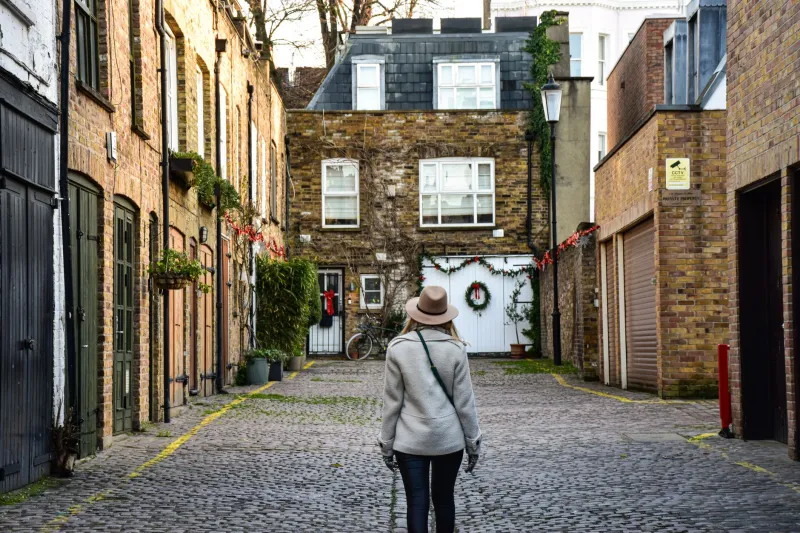
Choose a route with pavements and crossings where possible. Residential streets and cul-de-sacs are usually better than main roads, and they tend to have the best displays anyway. A quick look at your local Facebook group or the school gate chat will often reveal the streets that go full North Pole.
Block 2: The display intervals — ten to twelve minutes of stop-start effort
This is the engine room of the session. Pick five or six houses or streets with displays worth seeing. Walk briskly between them, then pause for 30–45 seconds to look. That is your interval: a short effort followed by a natural recovery.
You are not sprinting. Think purposeful walking — a bit quicker than the warm-up, enough that you feel warm under the coat. Use the displays as markers, not the timer on your phone. If the kids stop to press a singing reindeer, that is your recovery. If a neighbour comes out for a chat, that is also recovery. The plan bends; it does not break.
Keep safety sensible. Stay on the pavement, do not step into the road to get a better photo, and avoid blocking driveways. Watch for trailing cables, uneven paving and dark patches between lights. If you are with younger children, agree a meeting point at each display and keep them on the inside of the pavement.
A simple timer plan for the interval block: walk briskly for two minutes, pause for 30–45 seconds at a display, then repeat. Do five or six rounds. That is ten to twelve minutes of stop-start movement without anyone having to look at a watch.
Block 3: The cooldown — five to eight minutes back at home
Slow the pace for the last few streets. Let your breathing settle. When you get in, dump the coats, put the kettle on if that is your thing, and run through a short mobility block in the hallway or living room.
Try calf raises, hip circles, shoulder rolls and a gentle hamstring stretch. Hold each for a few breaths rather than chasing a perfect position. If you have been carrying a toddler or pushing a buggy, add some upper-back stretches and a few slow neck turns. The cooldown is not optional decoration; it is the bit that helps you feel human tomorrow.
The 20–25 minute plan
| Block | Time | What you do |
|---|---|---|
| Warm-up | 5 minutes | Brisk conversational walk, arm swings, ankle rolls |
| Display intervals | 10–12 minutes | 5–6 brisk efforts between displays, 30–45 second pauses |
| Cooldown | 5–8 minutes | Easy walk home, then doorstep mobility |
Making it family-proof
Let the children choose one display each. Bring a flask if you like, but keep the walk moving rather than turning it into a picnic in the cold. If you have a buggy, pushing it counts as extra resistance — no need to add anything else. If you have teenagers, give them the job of mapping the route or finding the next big display. Everyone likes a mission.
The walk does not need to be Instagram-perfect. Some houses will be spectacular; some will be a single string of lights and a hopeful inflatable. That is fine. The session is the point, not the display quality.
Why it beats another sofa night
This is not about punishing yourself for wanting to sit down. It is about giving the evening a different shape. A brisk walk in cold air can wake you up, clear the head and make the sofa feel earned rather than inevitable. It also gets everyone out of the house during the month when daylight is in short supply.
You do not need to do it every night. Aim for two or three lights walks a week between now and Christmas, and treat them as your December cardio blocks. Some will be 20 minutes; some will be 25 because somebody insisted on seeing the house with the flashing snowman one more time. Either way, you will have moved, warmed up and come home with a bit more festive goodwill than you left with.
That is the challenge for this week: pick a route, set a timer, and turn the neighbourhood lights into your session. The dark evenings are not going anywhere. Your streak does not have to follow them.