One Bell, No Radiator: The Cold Garage Plan That Beats a January Gym Queue
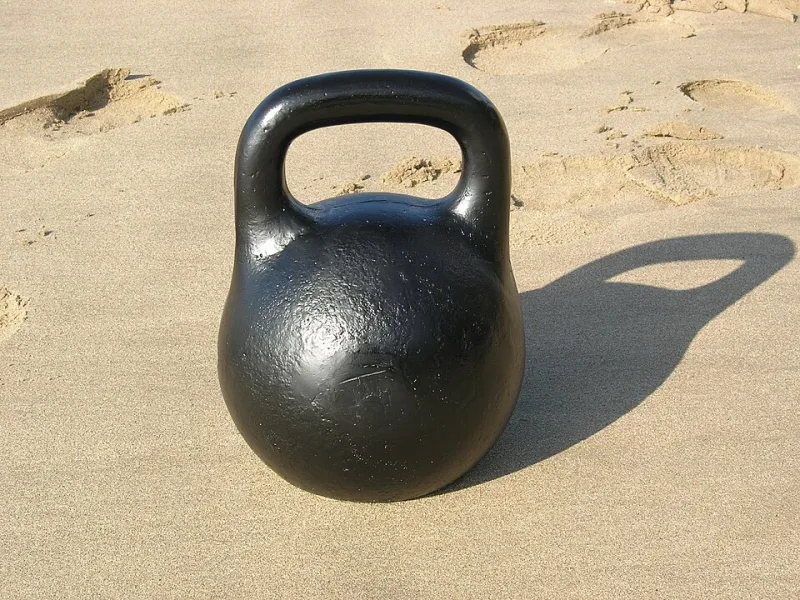
Photo: Detlef Romeike, CC BY-SA 2.5, via Wikimedia Commons
Every January the same advert appears: glass walls, mood lighting, a queue for the squat rack at 6pm. Meanwhile, twenty metres from your kettle, there is a garage with a concrete floor and a kettlebell in the corner that has been quietly waiting since October.
This is a six-week block for that garage. One bell, a timer, three sessions of twenty minutes a week. No membership, no queue, no radiator.
Why the garage wins
It is not about saving money, although you will. It is about removing the friction that kills winter training: the drive, the changing room, the walk from a cold car park, the twenty minutes of your evening that vanish before you have touched a weight. A garage session starts the moment you open the door and finishes before a gym-goer has found a parking space.
Cold is a factor, not a barrier. You will be warm within five minutes if the warm-up is any good, and you will be back in the kitchen with a brew while the gym crowd are still queueing for the bus.
The kit list (it is short)
One kettlebell. If you are buying your first, most women start around 8–12kg and most men around 12–16kg. If you can only stretch to one bell and you intend to swing it, err heavier rather than lighter — a 6kg bell is a paperweight with a handle. An adjustable competition bell solves the problem entirely if the budget allows.
A timer. Your phone, a cheap interval app, or an old kitchen timer that lives on a shelf. Something you press once and forget.
Floor cover. A mat or an offcut of carpet. Do not do lunges barefoot on bare concrete in November.
Layers and light. Base layer, hoodie, hat, and a clip-on lamp or headtorch. Assume the bulb has gone.
Five cold-weather checks before session one
- Clear the floor properly and check for damp or a leak you have been ignoring since last winter.
- Ventilate for a couple of minutes before and after. Cold air plus sweat equals condensation, and condensation equals rust on the bell and a slippery floor.
- Warm the handle. Metal holds cold and your grip will fail before your legs do. Gloves for the first set, then off.
- Wear trainers. Concrete steals heat from your feet faster than you think.
- Keep a flask of something hot on the shelf. It is a bribe, and it works.
The warm-up that earns its keep
Five minutes, no negotiation. March on the spot swinging the arms, ten slow bodyweight squats, ten hip hinges, ten arm circles each way, ten glute bridges, five slow kettlebell halos, then ten gentle swings with the bell at chest height before you take it overhead.
Cold muscles do not stretch well and cold joints do not like surprises. This warm-up is not padding; it is the reason you will still be training in February.
The six-week structure
Three sessions a week, twenty minutes each: five minutes warm-up, twelve minutes of work, three minutes of breathing and stretching. Pick three days and treat them like meetings with someone you cannot let down.
Session A — press and squat. Goblet squat, overhead press (right then left), reverse lunge holding the bell at chest, bent-over row. Alternate work and rest on the timer, four to six rounds depending on the week.
Session B — swings and carries. Two-handed swings, Romanian deadlift, suitcase carry down the garden and back, suitcase carry on the other side, finished with halos.
Session C — mixed grind. Clean and press, front squat, single-arm row, and a thruster finisher with light rounds.
Weeks 1–2: grooving the pattern
Thirty seconds of work, thirty seconds of rest. Five rounds of four exercises. Light and deliberate — this fortnight is about learning where your hips are, not about sweating. If your lower back feels the swings, the hinge is wrong; reset, chest up, drive with the hips.
Weeks 3–4: adding density
Forty seconds of work, twenty seconds of rest. Six rounds. Same exercises, slightly heavier bell on the hinge movements only. This is where the sessions start feeling like training rather than physio.
Weeks 5–6: the grind
Forty-five on, fifteen off, six rounds, plus a two-minute carry at the end of Session B. Keep one lighter week in reserve — if sleep has been poor or the week has been brutal, repeat the previous week rather than forcing progression. Nobody is marking this.
Scaling up and down
Complete beginner? Halve the rounds and use twenty seconds on, forty off. Swap swings for hip hinges with a glute bridge, goblet squats for box squats to a chair, presses for water bottles. The pattern matters far more than the load.
Experienced? Add a round rather than a session. Push the last round of swings to ten reps every minute on the minute. Use a heavier bell for deadlifts only.
Sore back or dodgy shoulder? Drop overhead work for a week and press at chest height. Get it looked at rather than training around it indefinitely.
Staying consistent when the radiator is off
Train at the warmest point of your day. For most people that is straight after work, before the house cools, or late morning at the weekend. Lay your kit out the night before so the only decision left is opening the door.
Use the five-minute rule: get changed, walk out, do the warm-up, and give yourself full permission to stop afterwards. Almost nobody stops. The hardest part of a garage session is the twelve feet between the kitchen and the kettlebell.
Miss one? Move it, do not delete it. Two sessions in a bad week is a win. Track the ticks on the garage wall in chalk, because a visible row of marks is a surprisingly strong motivator on a wet Tuesday.
What week six actually looks like
Not a transformation photo. It looks like this: a hundred swings without your back complaining, five clean presses per side, a warm-up you no longer need to look up, and three weekly slots that have quietly become part of the furniture. The gym adverts will still land in January. You will already be six weeks in.